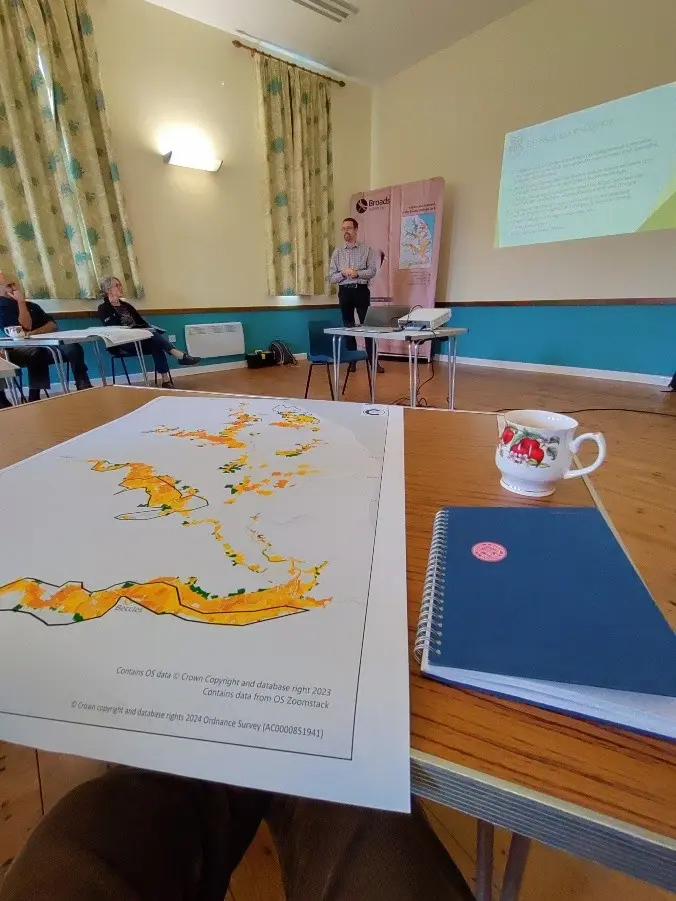
For the Lowland Agricultural Peat Water Discovery Pilot (LAPWDP) programme, we have been collaborating with project partners the Broads Authority, Cranfield University and the Norfolk Farming and Wildlife Advisory Group (FWAG) on the Broads Water Level Management project.
 This £150k project sought to explore water management issues arising from the need to conserve the remaining peat deposits in the Broads and minimise the related greenhouse gas emissions. Under low water levels, peat oxidises to produce carbon dioxide while if water levels are too high, methane is produced. At a depth of between 10cm and 30cm below ground level, overall emissions are minimised. The challenge for carbon and water managers is to balance field drainage requirements in the winter with water supply requirements in the summer so that the water table is stabilised at this depth.
Outputs from the project included a peat water table “opportunity” map for the Broads, a series of case studies, a report on the cost of new infrastructure for managing water levels in pumped IDB catchments, a groundwater modelling report on water demand for peat management and a film to be used for engagement purposes.
 Project success was built around an improved understanding of peat water table behaviour and the effect of scale on different management strategies, collaboration and the dissemination of information and knowledge. Key barriers and challenges included a lack of clear regulatory and permitting requirements and uncertainty about future design requirements for new infrastructure in pumped catchments in the Broads.
Reporting for the original project was completed in January 2024. This was followed by an £80k extension to the project, which is due to be completed in March 2026. A key element of this is a Broads water conference, to be held in January 2026 at which issues related to water and carbon management in the Broads will be presented and discussed.